Complexity Is Not Sophistication
Why the AI diagram is quietly making your organisation less safe — and what to put in its place
There is a slide going around. You have almost certainly seen a version of it.
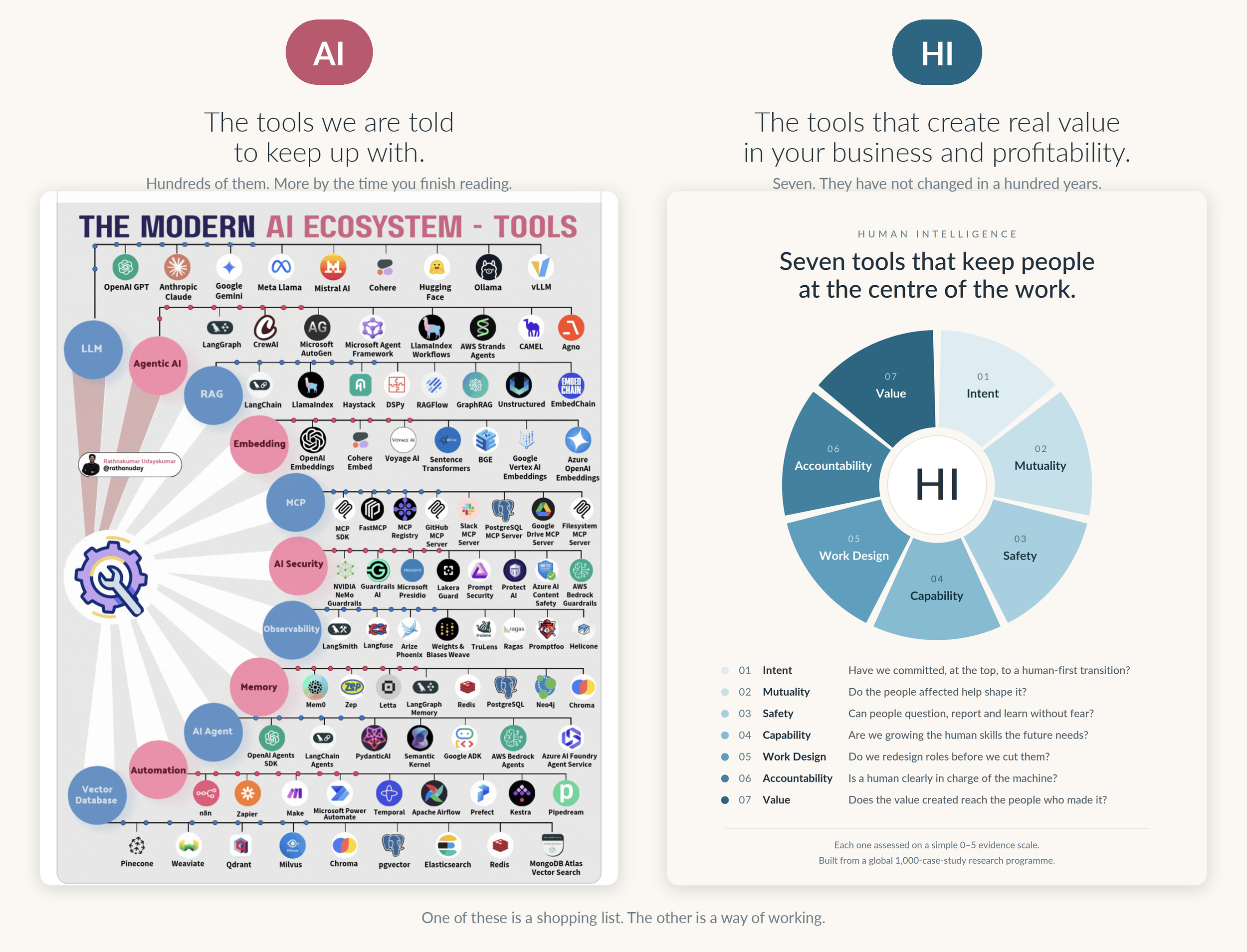
It is titled something like The Modern AI Ecosystem, and it is a wheel of logos. Models at the top. Then agent frameworks, retrieval tools, embedding services, vector databases, orchestration layers, guardrail providers, observability platforms, memory systems, automation engines. Well over a hundred names, arranged in a spray of tidy spokes, each one a company you are apparently meant to have an opinion about.
I want to be fair to it. It is not wrong. Somebody put real care into making it, and every logo on it represents people solving a genuine problem. As a map of an industry, it is accurate.
But watch what it does to a room.
I have presented to enough boards and leadership teams to know the shape of it now. The slide goes up. There is a small, polite silence. And something happens to the posture of the people in the room — a very slight settling back, a folding inward. Capable people, running real organisations, with decades of judgement between them, quietly deciding in that moment that this is not for them. That the future has arrived with a vocabulary attached, and they have not been issued the glossary.
Then someone says, "So where would you even start?" and everyone laughs, because it is funny, and because it is not.
That is the moment I want to talk about. Not the technology. The moment.
What overload actually does
We have a habit of treating that feeling as a personal shortcoming. The person who cannot hold the diagram assumes the problem is them — their age, their background, their failure to keep up. And because it feels like a personal failing, it gets managed privately. People nod along. They do not ask. They go home and worry.
It is not a personal failing. It is a predictable response to a badly proportioned amount of information, and it has been understood for seventy years. George Miller's famous observation, back in 1956, was that human working memory holds something in the order of seven items at once. Not seventy. Not a hundred and fifty. Seven, give or take.
So when we put a hundred and fifty items in front of a person and ask them to form a strategy, we are not testing their intelligence. We are exceeding a known limit and then reading the overflow as incompetence.
Here is why that matters far more than it might first appear. Cognitive overload does not just make people uncomfortable. It changes their behaviour in ways that are genuinely dangerous for an organisation.
Overloaded people stop asking questions, because asking requires holding enough of the picture to know what is missing. They defer, because deference is cheaper than comprehension — and in an AI context, deference means accepting the machine's output rather than interrogating it. They narrow, attending only to the fragment directly in front of them, which is precisely how a system-level failure goes unnoticed by every individual in the chain. And they go quiet, because in a room where everyone else appears to understand, the cost of revealing that you do not is high and immediate.
Now read that list again as a risk register. Fewer questions. More deference to automated output. Narrowed attention. Silence.
That is not a wellbeing problem. That is how organisations walk into their worst decisions with everyone present and nobody objecting.
The most expensive thing about that diagram is not the software it advertises. It is the silence it manufactures.
The wrong list
The deeper trouble is that we have confused two very different questions.
The first is what tools exist. That question has hundreds of answers, they change every quarter, and almost none of them will matter to your organisation in three years. The half-life on that diagram is brutally short. Print it, put it in a drawer, take it out in eighteen months, and you will find a museum piece.
The second question is what makes technology create value in the hands of human beings. That question has far fewer answers, and they are remarkably stable. They were true when the production line arrived, when the computer arrived, when the internet arrived, and they are true now.
We have spent three years teaching leaders to answer the first question when their actual job is the second.
And I understand the pull. The first question feels like progress. It has vendors and demos and a sense of momentum. The second question feels slower, and it asks something uncomfortable of the people asking it, which is why it gets deferred.
But the organisations I have watched genuinely succeed with this technology — and across roughly a thousand case studies, there are patterns you cannot unsee — were almost never the ones with the most sophisticated stack. They were the ones who had answered the second question honestly before they touched the first.
Seven
So here is the alternative diagram. Same circular shape, deliberately. A fraction of the content, also deliberately.
Intent. Has the organisation committed, at the top, to a human-first transition? Not a values statement. A decision, minuted, with someone's name on it.
Mutuality. Do the people affected by the technology get to shape it? The person doing the work knows where the work actually is. Designing around them rather than with them is how you automate the wrong forty per cent.
Safety. Can people question, report and learn without fear? When the system produces confident nonsense — and it will — your entire early-warning capacity consists of one person willing to say "this looks wrong" to someone more senior than they are.
Capability. Are you growing the human skills the future needs? Not tool training. Judgement, framing, synthesis, the ability to work well in situations no rule covers.
Work design. Do you redesign roles before you cut them? Cutting removes cost. It does not remove work. Only redesign removes work, and the difference shows up eighteen months later in the quality of everything you do.
Accountability. Is a human clearly in charge of the machine? Named, resourced, with the standing to switch it off. Diffuse accountability is not caution; it is the absence of a decision.
Value. Does the value created reach the people who created it? If the productivity gain leaves entirely through the top of the organisation, you will get the gain once and never again, because people are not stupid and they only volunteer their ingenuity where it is reciprocated.
That is the whole thing. Seven. It fits on a single page and inside a single human head, which is not a coincidence — it is the design requirement.
You will notice something about that list. There is not a single piece of technology on it. Nothing that will be obsolete next year. Nothing requiring you to have an opinion about vector databases. Every item is a question about people, and every one of them can be answered honestly by someone with no technical background whatsoever.
That is the point I most want to land. You do not need to understand the left-hand diagram to lead this well. You need to be honest about the right-hand one.
What this looks like on a Tuesday
None of this is worth much if it stays at the level of principle, so let me be concrete about where I would start.
Take the seven and ask which one you would least like to be asked about publicly, in front of your people, with a straight answer required. Do not deliberate. The one that produced the small flinch is the honest answer, and it is where your work is.
Then, before the next tool decision, sit with the work itself. Not the role description — the actual tasks, listed out, by the person who does them. In case after case the split between what is genuinely repeatable and what is judgement wearing a routine's clothing turns out to be nothing like what the org chart implied. You cannot see that from a vendor demo. You can only see it by sitting down with someone and asking them to walk you through their Tuesday.
And then ask the question almost nobody asks. When the technology gives us hours back, what will we spend them on? If the honest answer is "nothing, we will bank them", say so out loud, because your people will work it out within a fortnight anyway and it is better that they hear it from you. But if there is a better answer — the customer you could finally serve properly, the failure you keep catching too late, the junior nobody has time to teach — then name it now, before the hours arrive and quietly evaporate.
That is three moves. None of them require a budget. All of them require someone senior to be willing to be uncomfortable for an afternoon.
You are not behind
I want to end where the diagram starts, with the person going quiet in the room.
If that has been you — in a briefing, on a webinar, scrolling past yet another announcement at eleven at night with the low hum of having missed something — I would gently offer this. You are not behind. You are looking at the wrong list.
The hundred and fifty logos are not the substance of this transition. They are the scaffolding around it, and scaffolding always looks more impressive than the building while the building is going up. The substance is whether the people in your organisation are trusted, heard, safe to speak, growing, fairly redesigned around, clearly accountable, and properly shared with.
You already know how to do that work. You have been doing versions of it your whole career. The technology has not made your judgement obsolete; it has made it scarce, which is a very different thing and a considerably better position to be in.
Complexity is not sophistication. It is very often just complexity — and complexity that a human being cannot hold is not capability. It is risk.
Seven things. One page. Start there. And do a Human intelligence Accreditation with meetmagic.org
The rest will keep.
Matthew writes at The 5th Revolution on human intelligence, artificial intelligence, and why together is better. The seven domains come from a global program of 1,300 case studies, each assessed on a simple 0–5 evidence scale.
Related Articles